Please Share

Showing posts with label MIT. Show all posts

Tuesday, March 15, 2011

Hacking Your Own Jumbotron

I'm thinking that I found myself a diy project! Junkyard Jumbotron is the brainchild of Rick Borovoy, Ph.D. and Brian Knep at MIT's Center for Future Civic Media. I do believe that I have all of the required parts and I'll post my own video if it all comes together. Check out the video below, all you need to know is there.


Junkyard Jumbotron from chris csik on Vimeo.

Wednesday, September 16, 2009

MIT Students Capture Photos From Space - Budget $160.00

Three MIT students, Oliver Yeh, Justin Lee and Eric Newton, used common consumer electronics and a weather balloon to snap pictures from space. Dubbed Project Icarus the three who specialize in taking low-cost aerial photographs that they display and sell through a website called 1337arts, captured the photograph below from 28 kilometres up.


"The camera used in the project was a 7.1-megapixel Canon Powershot the students bought used on Amazon.com. They installed an open-source firmware add-on to the camera that would allow them to program it to take a picture every five seconds.

To track the location of the balloon, they used a $50 pre-paid Motorola cellphone with GPS capabilities and installed a free program that would report the phone's location at regular intervals. A USB phone charger powered by AA lithium batteries kept the phone running during the five-hour voyage. They also installed an external antenna to boost the phone's signal"

Perhaps NASA should hire a few more MIT grads!


Source: CBC

Friday, August 14, 2009

Businesses Spawned From MIT Classrooms Explore Innovative Cellphone Uses In Developing World

Projects developed, by MIT students and former students, both in the classroom and independently are proving the worth of cellphones as useful devices, beyond the obvious, and particularly in developing nations. Software developed as entries to MIT's IDEAS or $100K business competitions, or as part of the MIT Media Lab's NextLab program are being used to help residents of underdeveloped countries to increase their incomes, learn to read, navigate to where they're going and diagnose their ailments. The fact that cellphones are small, relatively cheap in comparison to computers, and increasingly more powerful and connected, makes them ideal for these countries that have little in the way of infrastructure. The MIT News provides details of some of the projects here.

Friday, June 12, 2009

MIT Team Develops Futuristic Bus Stops

Making its debut in October in Florence, Italy, the EyeStop is a new take on the traditional bus shelter. Providing such information as shortest bus routes, time to wait for in coming buses, air quality reports, and temperture, the EyeStop developed by the SENSEable City Lab at MIT will give commuters something to do while waiting for their ride. “You have a map where you just touch where you want to go and you will see in real time how to go there.” and “When there's lots of time, you will see a coffee cup so you can have a coffee before the bus arrives.” according to Carlo Ratti, head of the lab. EyeStop shelters will cost between US$5,000 for a basic EyeSpot – a pole designed for narrow streets – to $30,000 for a shelter with all the technology packed in.

Source: The Globe and Mail

Sunday, September 28, 2008

MIT's Autonomous Wheelchair

MIT researchers are creating an autonomous wheelchair that can learn the locations in a given building, and take its occupant to any given place in reaction to a verbal command. "It's a system that can learn and adapt to the user," says Nicholas Roy, assistant professor of aeronautics and astronautics and co-developer of the wheelchair. "People have different preferences and different ways of referring" to places or objects, says Roy, the aim is to personalize each wheelchair to its user and the user's environment. The wheelchair requires a first time guided tour to learn about it's environment, with the user providing verbal clues as to where it currently is. For instance, as the wheelchair is pushed around for the first time, the patient or a caregiver would say: "this is my room" or "here we are in the foyer" or "nurse's station." MIT News has the complete story here.

Friday, November 9, 2007

MIT creates search engine to aid students to find topics within video taped lectures

Wow, 2 AI / natural language recognition search related posts in one day! Faculty and students of MIT's Computer Science and Artificial Intelligence Laboratory (CSAIL) have developed a search engine that allows students to search video taped lectures as they might a text based web site. Lectures that have been video taped are fed to speech to text software that captures a transcript, the text is then divided into groups of words, or topics, that are analyzed for key-word density. Students can then query the search engine for topics and be guided directly to the portion of the video that best matches the query, therefor saving the trouble of scanning an entire lecture to find a specific portion. Best of all it's not just for MIT students, in fact its openly available thanks to MIT's OpenCourseWare initiative. Guess I know how my weekend is going to be spent! Give it a try! (Requires Real Player Plug in)

Thursday, October 4, 2007

Audit Berkeley lectures from home via YouTube

CBC is reporting that The University of California, Berkeley is making it's entire selection of course lectures available free of charge on YouTube. "YouTube's ongoing innovations create a great environment in which students and lifelong learners alike can discover, watch and share educational videos," said Ben Hubbard, co-manager of webcast.berkeley, in a release.

This is exciting news, combine these videos with free course material from MIT and you can see a real trend starting!

Friday, July 13, 2007

Walls made of water?

The CBC is reporting that MIT architects are planning to produce a building that has walls of water. The Digital Water Pavilion, will be created for Expo 2008 in Zaragoza, Spain, and will have walls of water created by thousands of computer-controlled jets. Using technology similar to an ink-jet printer, only on a much larger scale, the walls will be able to display images and be turned off or on in order to allow people to pass through them. The pavilion will house a cafe and at a cost of about $6000 per square meter, if my math is correct, I hope they sell a bunch of lattes! It's interesting in a technological sense but I don't think it would withstand our Canadian winters. Personally, I think this is a much better use of ink-jet technology and I'll bet it didn't cost $3,000,000.


Tuesday, June 12, 2007

Wireless electical supply

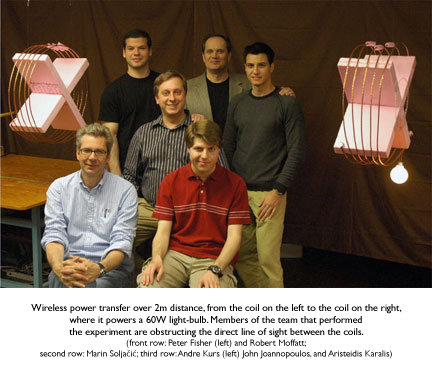
If researchers at MIT have it their way we may, some day soon, be free of the wires that tie our electronic devices to their power supplies. Imagine your cellphone charging on it's own without being required to 'plug in', or your laptop working without a battery or an AC adapter. Scientists have known for centuries of several methods of moving energy around without wires, but these methods are either inefficient or potentially dangerous to human life. The MIT researchers have been able to exploit the fact that two resonant objects of the same resonant frequency tend to exchange energy efficiently (the link above has a great explanation). Apparently the science is based on well-known laws of physics and could have been explored long ago had there been a demand for such requirements. While I am in awe of the thought of such developments, I think I'd like this to stay in the lab until we find out that it is really safe to be walking around in. Maybe these guys can get back together for a picture in a couple of years time... no horns or extra appendages and they'll get the thumbs up!


Search

Google