Please Share

Showing posts with label security. Show all posts

Thursday, December 23, 2021

My Tech Recommendation for 2022 - Wyze Cam v3

It's a little close to Christmas to make this a gift suggestion, though if you're lucky your local Home Depot may have one in stock, but if you are looking for a cost effective solution to home monitoring / security then the Wyze Cam v3 is tough to beat.

This little 2.4 GHz Wi-Fi enabled indoor / outdoor camera sells for just $33 US or $44 Canadian and has a terrific set of features:

  • Starlight CMOS Sensor for ultra low-light conditions
  • IP65-rated weatherproof with "extreme" temperature tolerance from -4°F to 113°F (-20°C to 45°C)
  • Local Storage (microSD card required) or store in the Cloud (limited to 14 second clips unless subscribed to Cam Plus)
  • 1920x1080p Full HD
  • 20 frames per second (fps) day time and 15 fps night time
  • 3 mounting options
  • Simultaneous 2-way communication via the Wyze app and camera speaker / microphone
  • Speaker can emit mini siren when triggered by the Wyze app
  • Near-IR and Far-IR lights for indoor and outdoor night vision
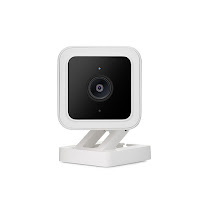
Wyze Cam v3

The object recognition is quite good with the Wyze Cam v3 and Wyze app, they're able to send alerts when recognizing simple motion or sounds (you set the threshold) but also can distinguish between vehicles, persons, pets, and packages and send specific alerts for each.
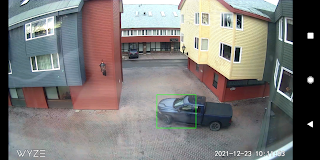

Wyze app vehicle detection

I have a Google Nest Hub and Wyze has made it simple to connect to that device, a single "Stream living room camera" command and the two work great together to act as a real time monitoring solution. You can also monitor through the Wyze app on your Android 5.0+ or iOS 9.0+ mobile device.
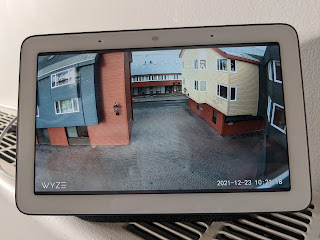

Google Nest Hub streaming camera video

If there is a knock on the Wyze Cam v3 it's fairly minor, in my case, but there are no battery options. It's USB powered via an included 6' micro USB cable / AC block which means you are limited to where you can place it based on proximity to an AC outlet and you'll have to provide your own backup power solution incase of power disruption. Of course your internet connection will also have to have a backup option or you'll need a microSD to save locally, but alerts will be affected without internet connectivity.


Saturday, June 27, 2009

For Your Eyes Only

If you work on sensitive projects or just have nosy cube mates, you may have wished you had a tool to keep prying eyes from seeing what you are working on. A company by the name of Oculis Labs Inc. has a solution for the super security conscious and another for the rest of us. Check out this demo by Oculis' founder and CEO, Bill Anderson.


Shoulder surfers beware!

Source:Baltimore Sun

Saturday, April 11, 2009

Conficker Getting Tougher To Detect And Eradicate

According to the New York Times, groups that track and defend us from malicious software are saying that the Conficker Virus is being updated and "... the most recent version, which began to appear Tuesday, appeared to be targeted at improving a peer-to-peer communications system between computers that are infected and hardening the system by making infected machines more resistant to anti-virus software." Additionally, "the Conficker authors have switched strategies and are using the program’s peer-to-peer mechanism to update the system. Originally, they had appeared to plan to download instructions to Conficker by generating new Internet addresses that infected machines could download instructions from."

No one has figured out entirely what the plot / purpose of Conficker is but it is being watched closely as it has infected millions of Windows machines world wide. According to Wikipedia "BKIS, a Vietnamese security firm, has announced that they found clues that the virus may be originated from China"

Friday, February 13, 2009

Microsoft Offers Reward For Worm Creator's Identity

George Stathakopulos from Microsoft's Trustworthy Computing Group has told the BBC that a $250,000 reward is being offered by the company to find who is behind the Downadup/Conficker virus. "Our message is very clear - whoever wrote this caused significant pain to our customers and we are sending a message that we will do everything we can to help with your arrest," said Mr Stathakopulos. One estimate has as many as 12 million computers being affected globally by Conficker/Downadup since it appeared in October.

On three other occasions Microsoft has offered such rewards. Rewards of $250,000 were offered for information leading to the creators of Blaster, MyDoom and Sobig worms. The perpetrators of those threats have never been caught.

Saturday, January 17, 2009

Windows Worm Spreads To 3.5 Million PCs

A Windows worm known as Conficker, Downadup, or Kido which was first discovered in October has a new viral variant that is causing concern amongst security firms. Even though Microsoft's MS08-067 patch protects users from the worm it has propegated to some 3.5 million machines worldwide.

According to Microsoft, the worm works by searching for the "services.exe" file and then becomes part of that code. It copies itself into the Windows system folder as a random dll fileand gives itself a 5-8 character name, such as piftoc.dll. The worm then modifies the Windows Registry to run the infected dll file as a service. Once up and running, it creates an HTTP (web) server, resets your machine's System Restore point (making it harder to recover from) and proceeds to download files from a malicious web site.

"There was a new variant released less than two weeks ago and that's the one causing most of the problems," Kaspersky Lab's security analyst, Eddy Willems told the BBC.

"The replication methods are quite good. It's using multiple mechanisms, including USB sticks, so if someone got an infection from one company and then takes his USB stick to another firm, it could infect that network too. It also downloads lots of content and creating new variants though this mechanism."

"Of course, the real problem is that people haven't patched their software. If people do patch their software, they should have little to worry about," he added.

Tuesday, January 6, 2009

Famous Twitter-ers Have Accounts Hacked

Twitter discovered yesterday that 33 prominent users of the service had their accounts compromised by an individual "who hacked into some of the tools our support team uses to help people do things like edit the email address associated with their Twitter account when they can't remember or get stuck." Those hacked included Rick Sanchez and Barack Obama. The tools were immediately taken offline to prevent further hacking and the company says they will only go live again when the security issue has been addressed. In addition, many users were also the target of a Phishing scam on the weekend. There can be no doubt now... Twitter is a hit!

Source: Twitter Blog

Saturday, November 1, 2008

Cache Of Stolen Financial Data Found By Security Lab

RSA FraudAction Research Lab reported on Friday that it had uncovered a large cache of credit card numbers and online bank account logins and passwords that have been accumulated over the past two-and-a-half years. The researchers say that a technically sophisticated trojan horse program, the Sinowal Trojan, likely originating in Russia is responsible. “Only rarely do we come across crimeware that has been continually stealing and collecting personal information and payment card data, and compromising bank accounts as far back as 2006. And in addition to its longevity, Sinowal has also been evolving at a dramatic pace – its rate of attacks spiked upwards from March through September of this year.” according to the researchers.

New York Times article.
BBC News article.

Friday, August 22, 2008

British Firm Loses Thousands Of Prisoners Data On Memory Stick

In another case of lost or stolen data, the British government is investigating the loss of a memory stick loaded with unencrypted personal data on thousands of prisoners, including names, addresses and release dates. The data was said to have been housed securely but an external contractor apparently loaded it onto a memory stick which has since gone missing.

"This was data that was being held in a secure form, but was downloaded onto a memory stick by an external contractor," Home Secretary Jacqui Smith said.

"It runs against the rules set down both for the holding of government data and set down by the external contractor and certainly set down in the contract that we had with the external contractor."

BBC story.


Friday, May 9, 2008

Facebook Agrees To Measures Aimed At Keeping Young Users Safe

Facebook has reached an agreement with the attorneys general of 49 states to institute a broad set of principles intended to protect young users from predators and inappropriate material online. Users under the age of 18 will be required to acknowledge reading Facebook's safety tips at sign up and the site will also display a prominent “report abuse” icon devised by the attorney general of New Jersey. Facebook will be closely monitoring users who drastically change their age on their accounts and has promised to take down offensive material within 24 hours of it's discovery. Facebook is said to be working on profiling technology to help it determine when someone is not telling the truth about their age. “We envision this as an ongoing process. We purposely built into this agreement the opportunity to raise and address new issues,” Connecticut attorney general, Richard Blumenthal said. “If we see a problem they’ll hear from us.” New York Times article here.

Friday, April 25, 2008

Hackers Warn Big Business That Attacks Are Imminent

A "Hackers Panel" which convened in London this week at the InfoSecurity Europe conference is warning big business that denial of service attacks, the likes of which shut down the websites of banks, governments and political parties in Estonia, are imminent. Big business is seen as definite targets "If someone wants to have a pop at the UK, they are unlikely to go for the government web servers. They will go for the lower hanging fruit - companies which are seen as good representatives of the country." said panelist Steve Armstrong from the SANS Institute for information security training. Some believe that these attacks can be thwarted if ISP's take a more active roll in policing their networks and identifying machines that are compromised and participating in bot-nets, while others say it is not the place of the ISP and that more money needs to be spent by businesses to defend against such attacks. Seems rather obvious that the white hat hackers and security firms would want to support the later... The BBC has more here.

Saturday, April 19, 2008

Paypal Will Block "Unsafe Browsers"

Paypal is vowing to block users from it's service who are using "unsafe browsers", customers will first be warned but will be blocked from the service if they continue to use the unsafe technology. Paypal says "an alarming fact that there is a significant set of users who use very old and vulnerable browsers such as Internet Explorer 4". In fact they claim that some users are still employing Internet Explorer 3 which is more than 10 years old! The company also said "In our view letting users view the PayPal site on [an unsafe] browser is equal to a car manufacturer allowing drivers to buy one of their vehicles without seatbelts." BBC story here.

Monday, March 3, 2008

Spotting Terror Cells In Online Worlds

The US government has apparently begun a project to spot terrorists at work in virtual worlds. "All of the major terrorist treatises have been distributed through the internet so taking it to a virtual world with multi-player role games is really an easy step." said Andrew Cochran, founder and co-chairman of the Counterterrorism Foundation. Roderick Jones, a vice president of Concentric Solutions explains "Just to feel their way around them and work out what new intelligence collection methods might be required to deal with this threat, because you won't be able to use traditional law enforcement methods." Seems like some of those online foes are more of a threat than one might have anticipated? The BBC has more here.

Tuesday, January 15, 2008

MySpace and States Agree on Safety Guidelines

According to the Globe and Mail, and many other sources, MySpace and 49 state Attorney's have agreed on a broad set of guidelines to help protect youth online. "MySpace, ..., agreed to take further steps to ensure safety, including developing an e-mail registry that would allow parents to prohibit their children from creating an online profile for the network, according to the attorneys general." With 110 million global users and much popularity with the younger set, MySpace was a natural target for the states. “This is an industry-wide challenge and we must all work together to create a safer Internet,” MySpace Chief Security Officer Hemanshu Nigam said in a statement. Texas was the only holdout state.

Tuesday, December 4, 2007

Passport Canada's website has serious security flaw

The Globe and Mail is reporting that an Ontario man was able to uncover personal information about other passport applicants when he was creating his own Canadian Passport request online. The hack occurred with a simple change of a few characters in the site URL, "I was expecting the site to tell me that I couldn't do that," said Jamie Laning of Huntsville. "I'm just curious about these things so I tried it, and boom, there was somebody else's name and somebody else's data." Mr. Laning is apparently an IT worker and immediately informed the Passport Office or his discovery. The site was taken down and apparently fixed, however when it came back up yesterday The Globe and Mail was able to view at least some data of other applicants including "names, addresses and numbers for references and emergency contacts." Glad I renewed by mail!

Wednesday, November 14, 2007

ZoneAlarm anti-spyware free if you act quick

It seems that Check Point is celebrating Patch Tuesday with a little gift... you can download ZoneAlarm anti-spyware from this link today, until 5:00 PM PST, for free! I've never tried their anti-spyware but can honestly say that I ran ZoneAlarm firewall for many years and was quite happy!

Wednesday, September 19, 2007

Yahoo and AOL Instant Messenger services exploited

c|net's News Blog is reporting that non-vendor disclosed vulnerabilities are targeting the Instant Messenger services of Yahoo! and AOL. There are no fixes from either vendor yet. The complete details are available from ZDNet blogger Ryan Naraine.

Friday, September 7, 2007

Port of Halifax employing new security measures, can you say minority report?

The CBC is reporting that the Halifax port authority will soon be scanning the veins in the hands of their employees. The technology known as vascular biometrics, created by Identica Canada Corp. of Toronto, is apparently much safer than scanning eyes. Vascular biometrics maps the veins in the employees hand and stores data on an id card, when an employee enters the port they will be required to swipe their card and place their hand on a scanner, the system uses pattern-recognition to determine if the identity matches. "So, you are guaranteed the person carrying the card is the person it was issued to." unless the terrorist is carrying a lobbed off hand... or perhaps I've been watching too many movies!

Saturday, September 1, 2007

Celebrating 25 years of computer viruses

The Globe and Mail has an interesting story about the first computer virus, created by Rich Skrenta in the 9th grade as a prank, the “Elk Cloner” was a self replicating program that was in effect the world's first “boot sector” virus. Skrenta has gone on the bigger and better things as a coder and business man but will likely always be known for this dubious honor. Little did he know what he had started!

Tuesday, July 10, 2007

Big brother watches New York City

Engadget is reporting that New York City will soon be under the watchful eyes of a London style "surveillance veil" consisting of thousands of video cameras monitoring people and vehicles. The "Lower Manhattan Security Initiative" will have more than 100 cameras in place by years end. The cameras will be capable of reading license plates and enable authorities to send out alerts if suspect vehicles are detected. The move is the start of a greater plan which will eventually see 3000 or so cameras by end of next year, as well as a series of gates that will be installed at intersections, giving the city the ability to block off traffic at the push of a button. The project which is being hotly debated on Engadget, is expected to be in full operation by 2010.

Monday, June 18, 2007

PC Health and Safety

If you are concerned about your hard drives health or want to know whether or not your system is exposed to Internet evil doers, then you should become familiar with Steve Gibson's GRC.com. While the popular SpinRite software is a commercial product for hard drive maintenance, Gibson also offers a number of free tools including ShieldsUp! a fantastic online tool that will identify open ports on your system in order to inform you of your PC's potential vulnerabilities. Steve is also co-host of the popular Security Now podcast with Leo LaPorte, while this show can often get a bit technical the duo does a great job of dumbing it down for general consumption. Everyone who has a PC connected to the Internet should give this site a visit.

Search

Google